The Unmissable Symbol of Gdańsk
“L’architecture est le grand livre de l’humanité.” – Victor Hugo
Hi, it's Loic !
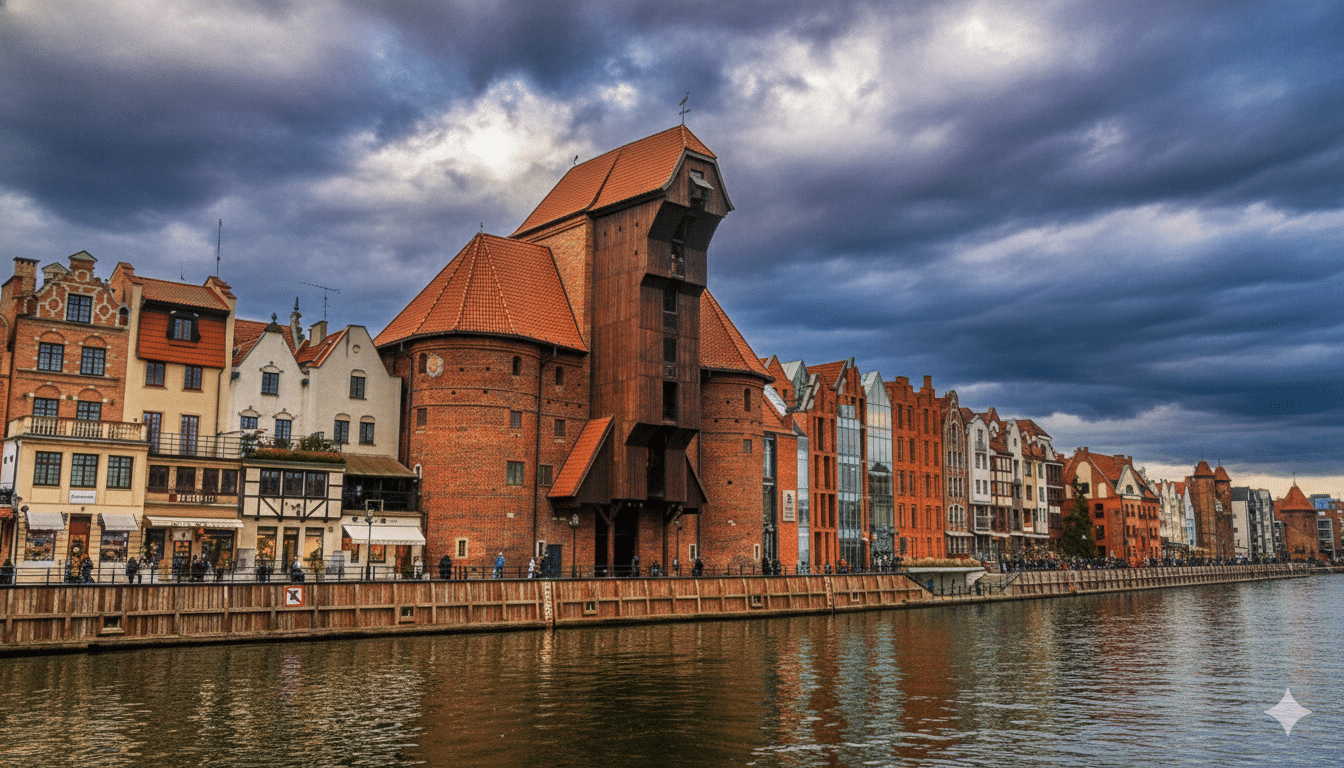
If you have ever set foot in Gdańsk, Poland, your gaze was inevitably drawn to this dark silhouette dominating the Motława River. It is the Żuraw.
But don’t be fooled: this is not just a "pretty façade" for postcards. This massive structure is the beating heart of the city's commercial history and a powerful testament to human ingenuity.
In this article from my Travel Diaries, I take you to decipher this brick monster. We will understand its little-known double role and dive into the depths of its secret mechanism. Ready for a journey back in time?
More Than a Crane: A Dual Identity
The Żuraw (which means "The Crane" in Polish) is a true survivor of History. Erected in its iconic form between 1442 and 1444, it holds a prestigious record: it is the oldest existing wooden port crane in Europe.
But during the era of the Hanseatic League, they weren’t building only for trade; they were building for survival. This building therefore had two faces:
- The Port Titan: Its primary function was heavy lifting. It was used to load barrels of beer and wine, and especially to install the gigantic masts on merchant ships.
- The Fortress: Look closely at its two round brick towers. They are not there for decoration. The Żuraw was a vital fortified gate, designed to protect the port entrance against invaders coming from the sea.
The Secret Mechanism: Human Power
This is where medieval engineering gets fascinating. Forget electricity or steam engines. Here, the engine was man.
The heart of the Żuraw houses two pairs of huge wooden wheels, called “treadwheels” (or squirrel cages). Imagine giant hamster wheels, exceeding 6 meters in diameter.
How did it work? Dockworkers literally stepped inside these wheels and walked in rhythm.
- As they walked, they turned the axle.
- The axle wound a massive hemp rope (as thick as an arm!).
- Thanks to this gear system, the power of a few men was enough to lift up to 4 tons to a height of 11 meters.
It is a physical and mathematical feat that commands respect, especially when you consider the working conditions of the time!
1945: Tragedy and Rebirth
If the Żuraw seems to have weathered the centuries without a scratch, it is an illusion. The recent history of this giant is much more turbulent.
The Hell of 1945
In the spring of 1945, during the fierce battles for the liberation of the city (then Danzig) between the Red Army and German forces, the historic center burst into flames. The central part of the Żuraw, made entirely of wood, acted like a torch. It was reduced to ashes. Of the proud medieval structure, only two shells of calcined and gutted brick remained. By the end of the war, the monument was destroyed by over 80%.
The Polish Phoenix
But the story doesn't end there. Instead of demolishing the ruins, Poland made the bold decision to reconstruct the Old Town identically. Between and 1962, passionate architects and craftsmen rebuilt the Żuraw, stone by stone, beam by beam. They reconstructed the lifting mechanism according to the original plans, giving the city its beating heart back.
What you see today is therefore not only a relic of the Middle Ages, but a symbol of resilience. It is proof that a city can rise from the ashes, more beautiful and prouder still.
Loïc's tips for visiting Gdańsk and its famous Crane
The Żuraw is more than just a monument for a photo from the quay. To truly enjoy it, here are my personal recommendations:
Don't stay outside! Many tourists are content with just looking at the facade, but that's a mistake. The building is an annex of the National Maritime Museum. I strongly advise you to buy a ticket to visit the interior. You will be able to climb inside the wooden structure and see the famous "squirrel wheels" with your own eyes. It's the only way to truly appreciate the gigantic size of the mechanism.
Le Spot Photo Parfait 📸 Vous voulez la photo “carte postale” sans la foule devant vous ? Ne restez pas au pied de la grue (vous serez trop près). Traversez le pont mobile vers l’île d’Ołowianka juste en face. De là, vous avez le recul parfait pour capturer le Żuraw se reflétant dans la Motława.
My tip: Go there during golden hour (just before sunset) or blue hour, when the city illuminations switch on. The contrast between the blackened wood and the red brick is stunning.
Practical Information: The museum is generally closed on Mondays (always check the opening hours before visiting). Allow about **45 minutes to 1 hour** for a complete interior visit.
The Soul of Gdańsk
The Żuraw is much more than just a landmark on a tourist map or a pretty background for your selfies. It's a survivor.
It embodies the very spirit of Gdańsk: a city of bold merchants, shattered by the fury of the war, but rebuilt with unwavering pride. This monument is the link between the medieval golden age and modern Poland.
So, when you pass under its massive gate during your next stroll, don't just look up. Spare a thought for the men who sweated in those wheels 600 years ago to build the city's prosperity, and for the craftsmen who raised those bricks, one by one, after 1945.
That is the real journey: not just seeing stones, but feeling the history they carry.
Happy discovering in Gdańsk, everyone!




Leave a comment